
Production deployment & automated deployer
Production deployment and an automated deployer: tagged releases, CI check first, rollback, GitHub reports
NexAgents (app.nexagents.cloud) puts production AI agents to work for a team — agents that answer reliably, per-person control over models, tools, passwords and company data, and metered token costs. Live in production; last deployed 3 Oct 2026.
Snapshot
Audited environment metrics verified against live deployment.
The challenge
The business context, constraints, and risk surface that shaped every decision.
Agents that answer well only some of the time, no control over who may use which models, tools, passwords and company data, and costs that add up because every message resends large prompts.
A team wanted to use AI agents at work but faced three gaps: unreliable answers, no access control over models, tools, passwords and company data, and rising costs as every message re-sends large prompts. Already in place: the open-source qm agent platform (forked July 2026) with Slack and web chat, per-person sandbox, memory, files, keychain, schedules, skills and web apps.
Contributions
Factual breakdown of our direct engineering contributions.
Production deployment and an automated deployer: tagged releases, CI check first, rollback, GitHub reports
Per-person model access and an admin console for models, budgets and usage per person and per agent
Employees build their own agents; @team splits a task across several agents
Data stores (Google Search Console, GA4, LinkedIn) granted to each agent separately, with spending caps
Token cost reduction and metering on every request
System / solution
Production stack: one VPS behind Caddy, four Docker app services, PostgreSQL state, Slack and web chat, Claude Agent SDK, and the qm agent platform.
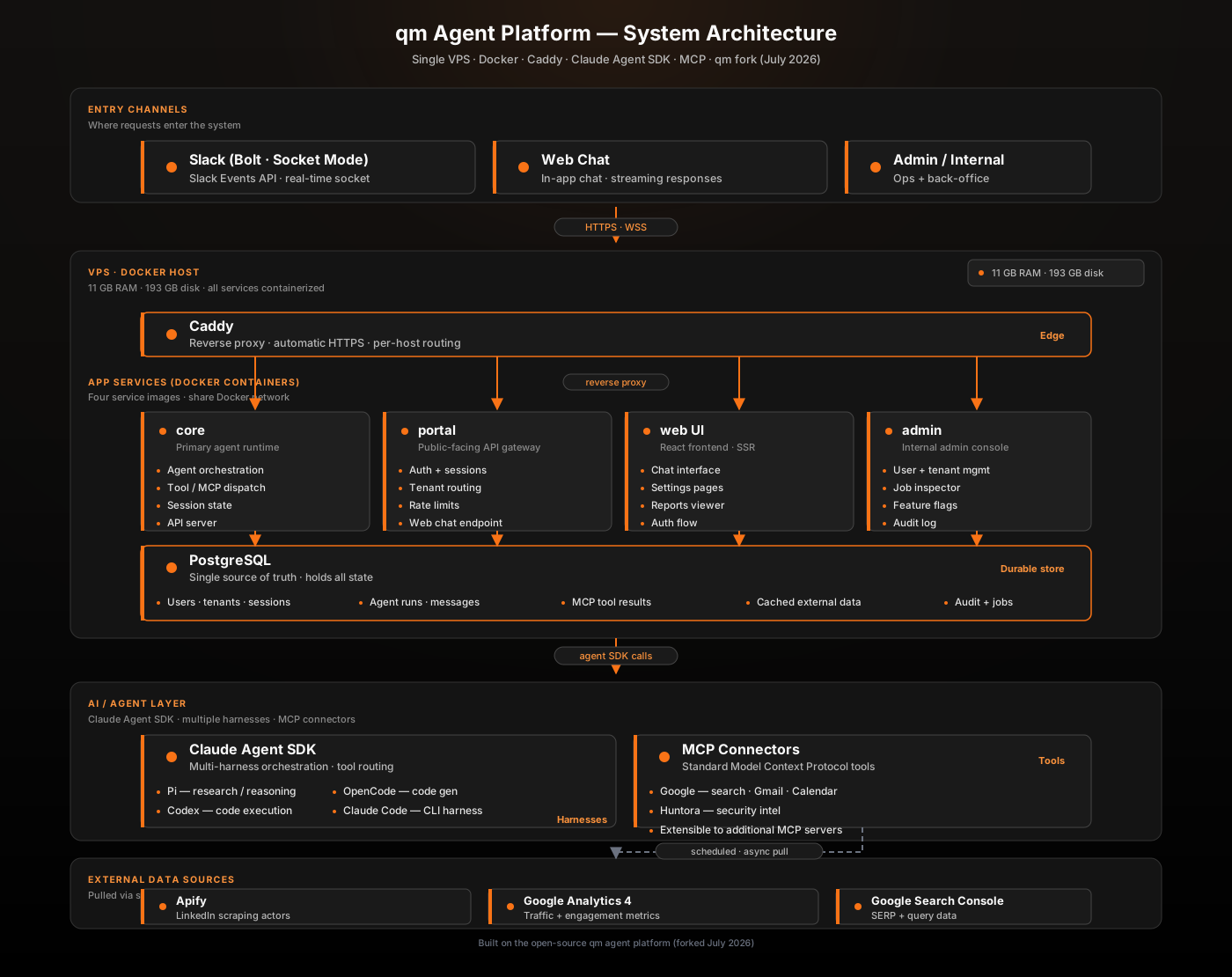
System architecture
One VPS (11 GB RAM, 193 GB disk) running Docker: four app services (core, portal, web UI, admin) behind Caddy, with PostgreSQL holding all state. Chat via Slack (Bolt, Socket Mode) and web chat. AI through the Claude Agent SDK with Pi, OpenCode, Codex and Claude Code harnesses and MCP connectors (e.g. Google, Huntora). Data from Apify (LinkedIn), Google Analytics 4 and Google Search Console. Already in place: the open-source qm agent platform (forked July 2026).
Flywheel impulse
Verified real-world deployment, maintenance, and scale protocols.
Live in production on app.nexagents.cloud (last deployed 3 Oct 2026). The automated deployer tags the running version, backs up the database, rebuilds and verifies on each tagged release — with a health check, automatic rollback, 4 kept backups and alerts through GitHub. Admins manage people, models, Slack setup and AI provider order in the admin console without a release.
Outcomes / evidence
Every metric listed is verified and sourced from the NexAgents case data.
Verified evidence
−74% input tokens on a measured turn (52.6k → 13.8k)
Stable cacheable prompt, trimmed tool output, tools loaded only when needed
Verified evidence
87% cache hit on the first step (14.6k of 16.9k tokens), ~6× cheaper
Prompt cache works between messages; it was hitting 0% before the fix
Key outcome
Safer releases — every change reviewed before merge and tested live in Slack
Automated deployer: health check, automatic rollback, 4 kept backups, GitHub alerts
Capabilities involved
Agentic Layer Engineering and Forward-Deployed Services were both demonstrated in production.
Agent builder where employees build their own agents; @team splits a task across several; data stores (Google Search Console, GA4, LinkedIn) granted per agent with spending caps — all in production.
Production deployment on one VPS behind Caddy with an automated deployer: tagged releases, CI check first, rollback, GitHub reports, 4 kept backups.
Related work
No related case studies exist yet for the NexAgents project.
Let's talk
Let's discuss the problem you're trying to solve.
Talk to our teamStop experimenting and start engineering. Let's discuss how we can turn your complex requirements into a deployed solution.


